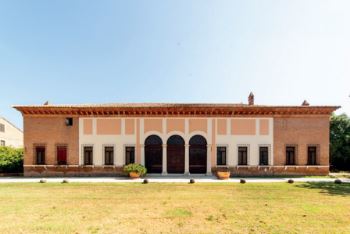

In the mid-1500s Marquis Francesco d’Este had a small palace built on Corso Giovecca for himself and his two daughters Marfisa and Bradamante, which he later connected with the present Palazzo Bonacossi: an entire block of palaces and gardens. In 1598, the year of the devolution of Ferrara to the Church State, Marfisa did not follow the d’Este family to Modena, remaining in
her home until her death. Characterized by a rich decorative apparatus created by the workshop of Bastianino (famous for having painted the Last Judgment in the apse of the Duomo) after Marfisa’s death, the mansion enjoyed alternating fortunes, until the Municipality acquired it and restored it to make it a museum. In 1929 the Municipality granted, in the space
between the two palaces, the construction of the Tennis Club, which was named after Marfisa and is still very active today.
Famous members included writer Bassani and director Antonioni.