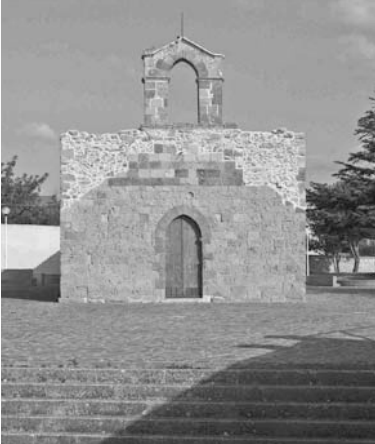
The church of St. Peter stands in an elevated position on the southwestern outskirts of the town, a short
distance from the church of St. Mary Magdalene (18th century). The factory is located on the site where the original village of Gueymajori (an appellation attested since medieval times) developed, abandoned by its inhabitants following a bloody plague epidemic, which peaked between 1651 – 1655 and 1681. In fact, to this period dates the transfer of the population to the valley, and the complete abandonment of the site, which was reused as a cemetery area. The construction of the church, of Romanesque layout, can be ascribed to the last quarter of the 13th century, although precise chronological indications on the age of its foundation, as well as on the construction events and the names of the workers are lacking. The current appearance of the entire building, although it has retained its original dimensions, is due to the significant reconstruction and restoration work carried out during the early 1970s. The work mainly involved the construction of the collapsed masonry and roofing, with the exception of the front wall face and part of the side walls, which escaped the collapses. On the facade plane is set a portal with a pointed arch-arched centina and a bell gable, also arch-arched, which gives momentum to the structure. The interior offers a rectangular single-nave room with wooden truss roofing, and a barrel-vaulted choir that houses three circular-section niches, carved sandstone, attributable to the 17th century. Among the few surviving furnishings are statues of St. Lucifer and St. Peter (17th century ?). The statues, both in painted wood, are of Sardinian craftsmanship. On the floor level of the hall, one can read the fragment of a stone inscription, made of pink porphyry and dated August 20, 1214, which reports news of the foundation of Santa Maria Maggiore, the original parish church of Guamaggiore, of which no evidence remains.