Siddi is a rural village that rises in the heart of Marmilla, a historical region in south-central Sardinia.
Its territory, which spreads between soft rounded hills and wide expanses of cultivated land (wheat and other crops, vineyards, vegetable gardens, almond groves and majestic centuries-old olive trees), is overlooked and protected by the basaltic Pranu ‘e Siddi plateau (giara), where low scrub, holm oak and some endemic species prevail.
These places, dotted with important archaeological and historical-artistic evidence, environmental and traditional beauty, museum spaces and art, good food and slow living, are the expression of an ancient and strongly identity-based civilization.
A hamlet of about 600 inhabitants that for a long time lived mainly on agriculture and pastoralism and is now working to enhance its heritage in a balanced relationship with its surroundings.
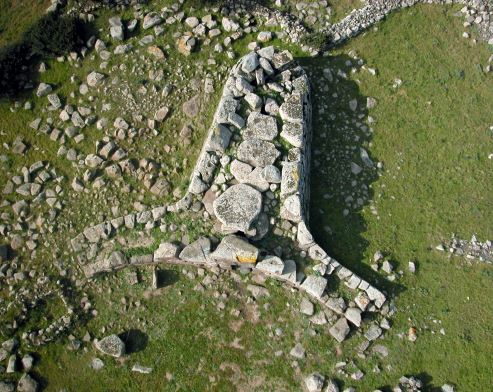
Of the various historical periods, the Nuragic period is the most present, with numerous testimonies: villages, nuraghi with simple, complex and corridor layouts (among all the Sa Fogaia and Conca Sa Cresia nuraghi), a majestic tomb of giants, Sa Domu ‘e s’Orcu, among the most extraordinary examples of Nuragic funerary architecture on the island.
In its very vicinity, a lithic ring was found that can be traced back more than six thousand years, representing the oldest evidence of human habitation in the area, including the surrounding area.
Man, in fact, settled here since the Neolithic period (the discovery of the valuable domus de janas of Scaba ‘e Arriu also testifies to this), certainly because of the fertile soils, springs and streams, areas suitable for pastoralism and the protection of the basaltic plateau.
Some settlement remains, ceramic fragments and coins testify to the Punic presence, while the findings of burials, cippus, habitation, coins, small treasuries with jewelry and fine tableware ceramics refer to the Roman period.
A belt buckle datable to the seventh century then refers to the Byzantine period.
Significant evidence within the village dates back to the Middle Ages, the Modern and Contemporary Ages.
Unfortunately, there is no definite information on the origins of Siddi, which are probably to be referred to the Roman age.
During much of the Middle Ages the village of Siddese was part of the giudicato d’Arborea, included within the historic curatoria of Marmilla. And precisely medieval are the earliest known documentary records (starting in 1346), with the village referred to several times as Silli.
From 1409 onward, with ups and downs, Siddi became part first of the barony of Marmilla, then of the county of Quirra becoming a marquisate in 1603, and redeemed of the Savoy state in 1839.
After the ransom Siddi remained an autonomous municipality until 1927, when it was aggregated with the town of Lunamatrona, becoming independent again on January 1, 1946.