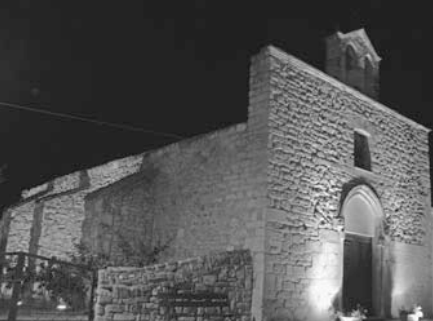
The Church of Carmine was built between the 15th and 16th centuries, located in the historic center is situated to the right of the cathedral and is dedicated to Our Lady of Mount Carmel. The building is characterized by a single nave with a wooden roof. The nave, with a rectangular plan, oriented according to the north-south axis, highlights on the right side an added compartment that serves as sacristy; on the left side a portal located between two buttresses that allows access to the garden. The roof is made of wooden beam warping. The masonry structure of the building is made of local stone, the interior and exterior masonry is as it was originally with exposed exterior and interior wall parameters. On the outside, on the longer sides, at the arches and headwalls, there are buttresses to complement the reacting wall sections. The façade of the church shows a single central entrance characterized by a portal surmounted by a pointed arch in molded stone with banded capitals with phytomorphic composite decoration; it shows a stone archway that allows the opening of a window. The Church of the Carmine preserves a prestigious historical and artistic heritage inside, which has undergone numerous restorations. Notable works include: the polychrome wooden altar; the balustrade; the wooden pulpit; numerous simulacra; and a holy water stack. According to hagiographic tradition, the feast of the Blessed Virgin Mary of Mount Carmel is a Marian memorial of devotional origin. In Palestine, Mount Carmel was a destination for many anchorites after the death of Jesus. Some Christians, dedicated the first temple to the Virgin, who took the name Our Lady of Mount Carmel or Carmel, on Mount Carmel. This became in sufficient to contain all the Christians who gathered in prayer around the early Carmelites, and there were thus numerous hermits devoted to the Virgin scattered first in Palestine, and then in Egypt and throughout the East.