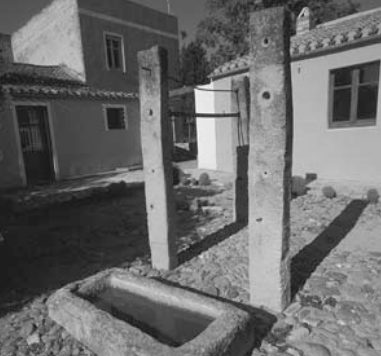
The Sa Domu Nosta Civic Museum is housed in a 19th-century manor house in Senorbì, built near the parish church of Santa Barbara. Its establishment dates back to the early 1980s, and was dictated by the need to enhance in the area the rich and important furnishings of the Punic necropolis discovered a few kilometers south of the modern urban center. The permanent collection occupies three rooms. The first exhibits artifacts from the Senorbì territory, spanning from the Recent Neolithic to the medieval age (4th-3rd millennium B.C.E. – 14th century A.D.). The showcases devoted to prehistory contain lithic and ceramic objects from the Culture of Ozieri, Monte Claro, Campaniforme and Bonnanaro, found in both necropolis and open-air villages. The fine workmanship of obsidian and flint instrumentation and the rich decorations of glasses, cups and tripods testify to the articulated standard of living attained by these peoples, as well as to the trade and migratory currents that affected European regions and the Mediterranean basin. Also present are attestations pertinent to the Nuragic Civilization, the most important monument of which, in the current state of studies, is the nuraghe of Sisini. A substantial lot of material comes from the Punic-age settlement of Santu Teru, which soon became a flourishing urban center, as evidenced by the collection of numerous artifacts of Greek and Central Italic origin during surface reconnaissance. Evidence from the early medieval and medieval periods concludes the tour. The second and third rooms house materials found at Monte Luna, where between the 5th and 3rd centuries B.C. the people who inhabited the Santu Teru hill in front were buried.