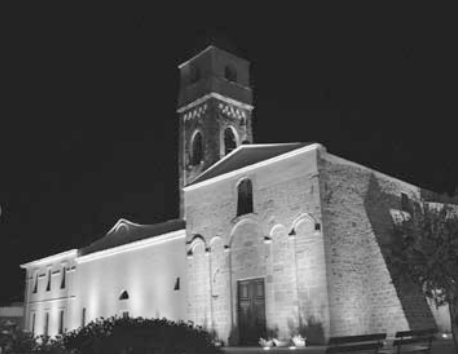
Among the buildings of worship in Suella’s historic center special mention should be made of the former cathedral, now the parish church dedicated to St. Peter the Apostle, built, according to ancient historical sources, around 1215 in the Romanesque-Pisan style. The architectural structure has undergone numerous transformations over the centuries; of the medieval structures of the first thirteenth-century layout there remain: an ancient wall frieze on the facade; on the northern side some small hanging arches resting on corbels a splayed single lancet window with a pointed arch centina decorated with an eagle, while inside there is only a trace left in the bell tower cell where several phytomorphic and zoomorphic corbels can be admired. During the period of Spanish domination between the 15th – 16th centuries, the appearance of the cathedral changed radically according to the new Gothic-Catalan trends: thus the Capilla Mayor was built with a square plan and a star vault, the three side chapels of which two on the right and one on the left, and the sacristy, while on the outside the buttresses were built. The upper orders of the bell tower, which rested on a Romanesque base, were raised according to the new Catalan taste. Inside on the high altar is a prestigious retable dating from 1535 attributed to the Stampace workshop of Cavaro, of which the Ecce Homo located in the predella and more specifically in the projecting tabernacle is a splendid invitation to pause and admire. In addition, one can admire numerous sacred objects and statues of great value donated over the centuries by devotees. Inside the building, in the nave in the Aragonese Gothic style, in the third bay leaning against the left purlin, it is possible to admire the wooden pulpit and paravoce dating back to 1634. This work has undergone careful restoration following the directives of the Superintendence of Fine Arts.